HVDC

Let’s get nerdy
TL;DR lots of power per line, expensive converter stations
While most power in the US is AC (Alternating Current), another approach for transmission lines is to use High Voltage Direct Current (HVDC) technology.
In fact, Dominion is already proposing HVDC for part of Virginia’s main power backbone: an underground direct-current line that would end in Loudoun. (Loudoun Now)
- HVDC has higher voltage and can carry more power.
- It has fewer losses over longer distances and can be less complicated to bury underground (fewer cables). Direct current also performs better underwater than AC for lines longer than 30 miles.
- HVDC above ground can be configured to carry significantly more power than is generally used underground, and above ground is preferred for extremely long HVDC lines because of improved electrical performance above ground.
- HVDC transmission lines are less expensive to build per mile than AC lines,
- The endpoints of the line require expensive AC/DC converter stations (about $400 million for each end). Thus, HVDC is usually reserved for cases longer than about 200 miles, but there are exceptions for circumstances in which the DC characteristics are necessary, such as when interconnecting two AC grids that are not synchronized (e.g., the western and eastern grids or Texas in the United States.)
HVDC has been in commercial use for 70 years. The first commercial line was built in Sweden in 1954 after 25 years of R&D. That line has been expanded twice and most recently upgraded in 2018. There are only five HVDC lines in the US, the oldest of which was built in the 1970s. Cables have continued to evolve with XLPE underground cables first used in 2002. Dominion used this technology in 2008-10 for doing the underground portion of the 230 kV line along the W&OD trail.
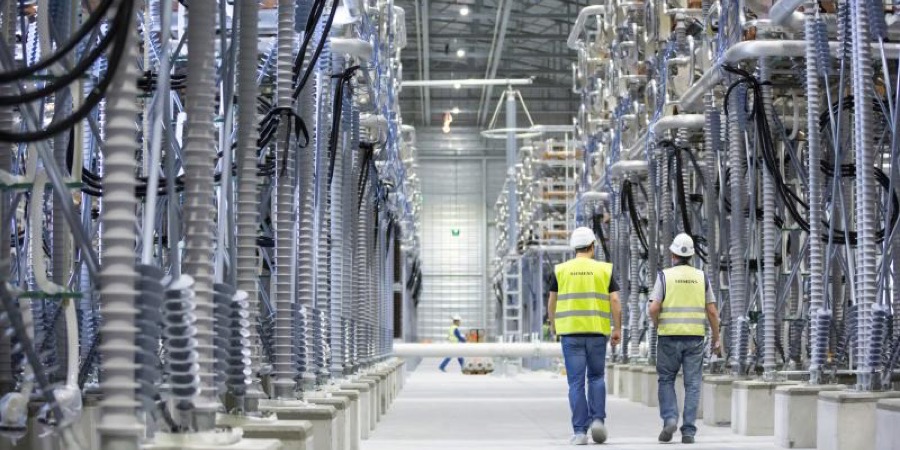
Converter station
HVDC continues to evolve to allow for higher voltages (more power) and longer lines. World leaders in such deployments are China and Brazil. The technologies that continue to be developed include high-speed circuit breakers and multi-terminal deployments, both required for the ongoing development of HVDC grids (vs. individual point-to-point deployments). The UK, Germany, Norway, Sweden, and Denmark are cooperating on building toward a grid centered around North Sea wind generation. India and China are working with Europeans to deploy these concepts for their grids.
For scale, the world’s longest HVDC lines run nearly 2,000 miles, in China.
Here’s a good video illustrating the design of a Canadian combined underwater/above ground line. Note the use of both transition stations (between water and above ground) and converter stations (between AC and DC):
HVDC – Muskrat Falls Project (gevernova.com)
https://resources.grid.gevernova.com/hvdc/hvdc-muskrat-falls-project
Want a deep dive? See StopMARL Virginia’s page on underground HVDC.